Research Topics
Our group focuses on computational linguistic analyses of digital media. Particular research topics of interest are:
- harmful language online, such as disinformation and hate speech
- discourse and dialog structure
- machine learning approaches to social media discourse
- computational analysis of non-literal meaning
- linguistic variability in digital media
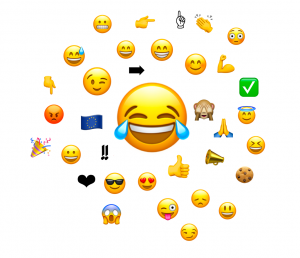
- emojis and other linguistic social media phenomena
- computational approaches to QUDs
Research Output
Current Funded Projects
Semantics and pragmatics of emojis in digital communication 1/2
- DFG Priority Programme "Visual Communication" ViCom; DFG, 2022-2028
- PIs: Tatjana Scheffler, Patrick Grosz (Oslo)
- project website
In this project, we investigate the explanatory power of iconic and symbolic approaches to emoji semantics via corpus analysis and a set of experiments that explores the continuum between pictorial and symbolic emojis. Starting from the hypothesis that face emojis are composed of (iconic or symbolic) minimal units, we study how existing and novel emojis are processed semantically. This empirical basis will allow us to differentiate between the proposed iconic and lexical approaches to emoji meaning and develop a hybrid semantics.
Virtual Common Ground: Language and Virtual Identity
- SFB1567, subproject D03; DFG, 2022-2026
- PI: Tatjana Scheffler
- project website
The subproject investigates the question of which linguistic means are used to construct and maintain the Common Ground in virtual communication. Using corpus and computational linguistic as well as experimental methods, two primary phenomena are investigated: the indication of group membership through positive speech (the counterpoint to hate speech), and the construction of virtual identities via linguistic self-representation, as well as via the adaptation to interlocutors in virtual life worlds.
Disagreements and their limits in discourse structure annotation: From insights to machine learning
- SFB1287 (U Potsdam), subproject C11; DFG, 2026-2029
- PIs: Manfred Stede (U Potsdam), Tatjana Scheffler
- project website
Project C11 investigates Human Label Variation (HLV) in pragmatic annotation, challenging the traditional “single ground truth” assumption, and examining its potential as a meaningful signal for discourse structure. The project will identify causes of both inter- and intra-annotator disagreement, to inform new HLV-enriched discourse models. The project will develop input representations and evaluation schemes for machine learning under HLV, which ultimately may benefit downstream tasks. By addressing the hidden limits of discourse annotation variability, C11 contributes to CRC Cluster C’s focus on Hidden Variability.
Metaphor and social positioning in religious online forums
- SFB1475, subproject C04; DFG, 2022-2025
- PIs: Tatjana Scheffler, Frederik Elwert (RUB CERES)
- project website
„Metapher und soziale Positionierung in religiösen Online-Foren“. Das Projekt erforscht, inwiefern Metaphern sozialer Rollen in den Äußerungen von religiösen Laien in Online-Foren verwendet werden. Inhaltlich steht der Einsatz von Metaphern zur Abgrenzung verschiedener Gruppen im Fokus. Auf methodischer Seite erforscht das Projekt computerlinguistische Methoden, die die Diskursstruktur der Foren nutzen, um Metaphern in großen Datenmengen teilautomatisch finden und interpretieren zu können.
Other Projects
-
"DEDICAITE – DEtecting AI-generated TExts in a DIdactic Context" In Kollaboration mit dem St. Josef-Hospital und der Abteilung für Medizinische Informatik, Biometrie und Epidemiologie
-
PostDocLab "A Multi-dimensional Approach to Advancing Disinformation Research: Narratives, Effects and Counter Structures", College UA Ruhr
Recently Completed Projects
-
SFB1287 (U Potsdam), subproject T01 "Transforming text across media"; DFG, 2021-2025
-
noFake: Crowdworking, digital platforms, social media, Projektwebseite; BMBF, 2021-2024
-
SFB1287, subproject A03 "Discourse Strategies across Social Media: Variability in Individuals, Groups, and Channels"; DFG, 2017-2021
-
Lehrprojekt: [Digitale Analyse großer Textkorpora]; RUB "Forschendes Lernen", 2021-2022
-
Lehrprojekt: LIMELDAS, Empirisches Arbeiten mit linguistischen Daten; RUB "Forschendes Lernen", 2020-2021
Resources
Linguistics of Emojis
We maintain the public Zotero library on papers related to the linguistic analysis of emojis. You can view or use the library here.
If any references are missing, you can suggest additions to the library via this online form.